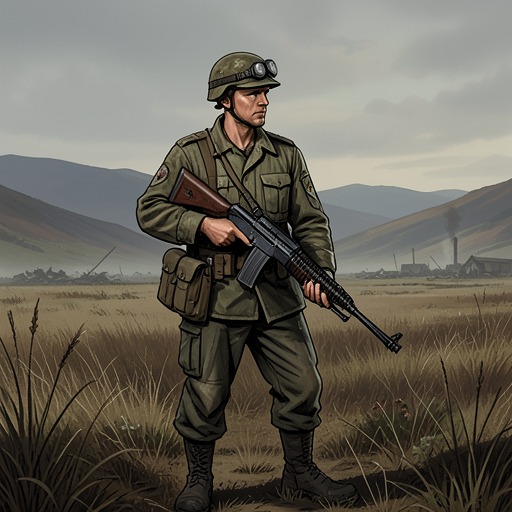
Pensacola
News of the WorldPensacola is the military post where Jefferson Kyle Kidd’s service as a runner takes shape: after being sent there to transport prisoners, he learns the work of military custody, then talks his way into the message corps. The city marks a sharp change in his duties, from guarding and managing prisoners to carrying information through the wilderness—the vocation that later gives his life its enduring direction.
Setting and Approach
After the Battle of Horseshoe Bend, Kidd’s militia and regular forces moved south toward Pensacola. The march passed through country locally called Alabama, which the United States government designated Mississippi Territory, and descended from hill country into sawgrass country. Fan palms stood high enough to rake his hip wound; green briar vines crowded the route with thorns. A company musician played the Irish tin-whistle tunes “Stone Grinds All” and “Little Drops of Brandy” repeatedly along the way.
Prison Duties
At Pensacola, the Army assigned Kidd to transport prisoners, a job he hated. The post’s work nevertheless gave him practical knowledge of confinement and coercion: he learned interrogation methods and the secret codes British prisoners used to communicate with one another. He also learned wrestling holds, including a thumb lock, the uses of manacles and leg irons, and the maintenance of prisons in the hot sands of the Gulf Coast.
From Custody to Messages
Within a few months, Kidd talked his way out of the Provost Marshall’s unit and its commanding officer’s managerial control, transferring into the message corps. There he carried messages, orders, maps, and reports by hand through the Southern wilderness. Andrew Jackson’s army had no comparable signaling capacity to the Navy, so runners supplied a vital means of moving information between units.
Kidd was well suited to the work. Already over six feet tall, with a runner’s muscles, good lungs, and knowledge of the country, he found that covering ground at a long trot came naturally. He had grown up in Ball Ground, Georgia, in the Blue Ridge; traveling alone and unencumbered with a message in hand pleased him, regardless of what the message contained or ordered. His routine was direct: he ran at the far edge of the Tennessee Regulars, saluted an adjutant at a staff tent, took instructions, put the messages in his bag, and set off.
Significance in Kidd’s Life
Pensacola is remembered not simply as a posting but as the hinge between work Kidd detested and work he loved. The experience of prison transport taught him the mechanisms of military custody, while his move into the message corps gave him the independence and purpose he associated with carrying information. That earlier life as a courier later informs his reflection that a person may have a message to carry through life, even without knowing what it means.